
Identifying The Advantage

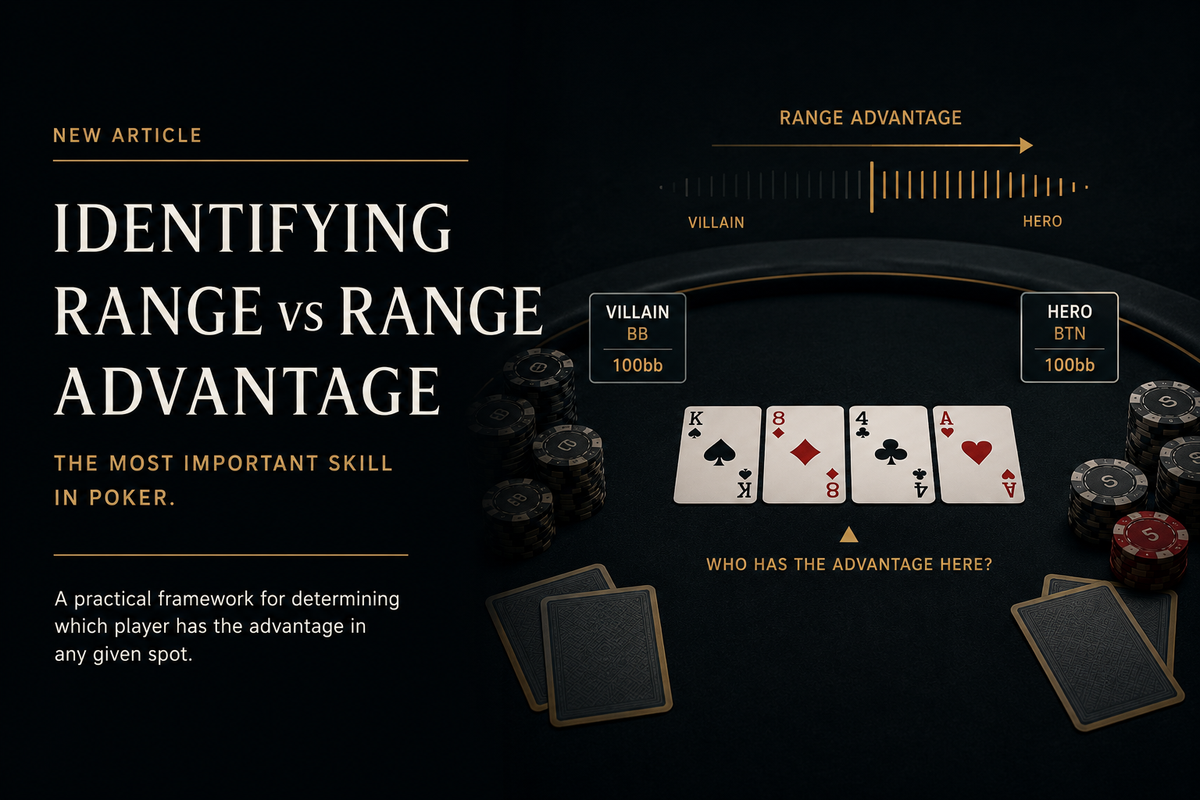
Becoming more competitive at poker requires lots of study and play. Through that study, you will learn many different concepts that you will use repeatedly throughout your time playing. One important concept is range advantage. You may have heard the term thrown around before, but it is important to fully understand what range advantage means and how to utilize it consistently.
Recently, I have been playing 200NL online. I started a bankroll challenge to climb to 5000NL online from lower stakes. I played a hand with A♥️Q♥️ that illustrates the concept of range advantage and why being the aggressor preflop does not always translate into being the aggressor postflop. I will review the hand street by street while I unravel the idea of range advantage and why our opponent made a mistake.
200NL 6-max 150bb effective stack
(Hero) A♥️Q♥️ UTG: raises to 2bb
HJ: calls 2bb
SB: raises to 13bb
We are facing a squeeze play where the SB 3-bets are large versus two players. It does not make sense to 4-bet AQs as a bluff since we are ahead of the weaker hands that the SB will 3-bet, and it is not a good 4-bet for value because the strong portion of the SB’s range is dominating us. I call.
(Hero) A♥️Q♥️calls
HJ: folds
Flop [9♥️ Q♦️ 7♦️]
Pot: 29bb
SB: bets 14.5bb
The SB makes a mistake here. If they are not thinking about how well my range interacts with this flop, it is easy to misfire here. Many players incorrectly treat the SB continuation bet as an automatic decision.
A couple of key points: I raised UTG, which is the tightest position at the table. A player called the HJ, which is the second tightest position, then the SB raised against two strong ranges. The SB range for a squeeze play here is very strong. Once I defend against this squeeze, my range becomes strong and narrow. The two highest frequency hands in my range are QQ and AQs. When the flop comes queen high, it will connect best with my queen-heavy range.
I have the range advantage on the flop despite the SB raising preflop because my range often includes top set or top pair. This means that the SB should be checking 100% of the time, even though they were the aggressor.
Here is a visualization of what both ranges look like in this scenario. The orange shading within a hand shows the frequency of the hand. A fully shaded orange box means 100% frequency. Notice how in UTG’s range, QQ and AQs are fully shaded in. Frequencies of a certain hand are more likely to happen online, where players tend to randomize their actions, but still occur in live poker if a player does not always take an action consistently with a certain hand.
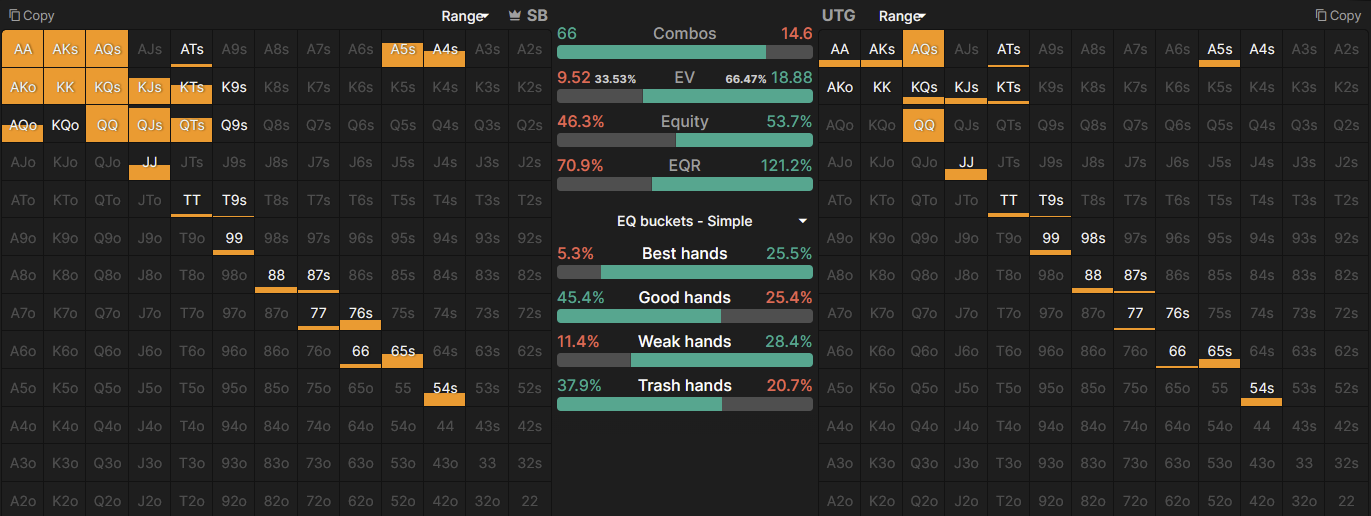
Now you may think, “The SB has lots of AA, KK, and QQ too!” However, the SB will also have plenty of weaker hands on Q97, such as AK, 54, A5, and A4. Because UTG has a condensed range that interacts well with queen high, UTG has more “best hands” than the SB.
When a range has more best hands than another, that is a good indication that they have the advantage. Another indication is the total equity that the range has against the other player. Looking back at the example, there is a comparison in the middle of both players’ equity; UTG has the advantage there as well. Because UTG’s range is mostly strong hands and the SB has more trash hands, the overall equity of UTG’s range is favored.
So what does this all mean?
Equity and best hands advantage make up what is often referred to as a range advantage. Between two players, range advantage will dictate whether or not a player should be aggressive or passive. In this case, the SB should have been more passive, and because this flop is an extreme example, they should have checked 100% of the time!
Scenarios like the AQ hand happen in plenty of other ways. After 3-betting or 4-betting, players make the mistake of automatically cbetting instead of taking their time to analyze which range has the advantage. It is easy to think that because you were the last aggressor with a strong range, you should cbet a high frequency. To avoid making this mistake, here are some questions I ask myself before every decision that you can use:
- Given the action and known cards, how does my range connect with this flop (equity advantage), and do I have the best hands more or less often than my opponent? (best hands advantage)
- How strong is my holding relative to my entire range?
- Given the answers to 1-2, do I want to play more aggressively or passively in this scenario?
It may seem overwhelming at first, but over time, it will become second nature to know which scenarios you will have the range advantage or not.
Finally, let us go over a hand together where we employ the three questions and evaluate our position.
200NL 100bb effective stack
UTG: Raise to 2bb
(Hero) A♥️ J♥️ BB: calls.
Pot: 4.5bb
Flop [A♦️ K♥️ 5♦️]
The first decision was whether or not we would call the BB versus the UTG raise. AJs is a hand that you could 3-bet, but also plays well as a call; either option is good here, so we call this time. The next decision is on the flop. Technically, the BB has the action first and can bet! Again, players tend to automatically check to the aggressor without analyzing who has the advantage. In this case, with the ace high flop, it is correct to check, but on flops like 7♦️6♥️5♠️, the BB should consider betting because they have more best hands than UTG’s tight range.
(Hero) BB: Checks
UTG: Bets 4.5bb
UTG bet the pot on a flop in which they have the best hands and an equity advantage. This is a good time to start asking yourself the questions above.
- Given the action and known cards, how does my range connect with this flop (equity advantage), and do I have the best hands more or less often than my opponent? (best hands advantage)
The BB defence range is filled with weaker suited hands, and none of the best hands like AA, KK, or AK, so this flop is not connecting well with our range, so UTG will have the range advantage and the best hands advantage.
- How strong is my holding relative to my entire range?
Despite the disadvantage versus UTG here, AJs is a strong hand for us. It is the strongest holding we can have outside of AQ, A5, and 55.
- Given the answers to 1-3, do I want to play more aggressively or passively in this scenario?
Since we have a disadvantage on this board, and our opponent is playing aggressively, it makes sense to play passively here and continue by calling with hopes that our opponent is playing aggressively with a weaker hand (bluffing).
(Hero) BB: Checks
UTG: Bets 4.5bb
(Hero) BB: calls.
Pot: 13.5bb
Turn: [A♦️ K♥️ 5♦️] 7♠️
The seven doesn’t change much, but the action on the flop has an impact on the advantage of UTG. UTG bet big on the flop, and the BB called, so UTG has to consider that the BB may also have a strong hand. The advantage UTG initially had on the flop has now lessened. In fact, the BB has an equity advantage at this point, but still lacks the best hands that UTG has. It’s not a range advantage for the BB, but UTG needs to be cautious.
(Hero) BB: Checks
UTG: Checks
Pot: 13.5bb
River: [A♦️ K♥️ 5♦️7♠️] 2♣️
Once UTG checks back on the turn, the BB has the range advantage. Hands like AA, KK, AK, and AQ would have bet the turn, so now BB’s AJ is often going to be the best hand, and the BB should be aggressive here with a bet.
(Hero) BB: bets 7bb
UTG: Calls
UTG: shows A♠️T♠️ and BB wins the pot.
In poker, the known cards and advantages are always changing in each hand, and your decision-making must revolve around how things progress. Practice asking yourself the three questions, stay focused on how the hand develops, and you will be on your way to understanding and utilizing the range advantage. Good luck at the tables!